
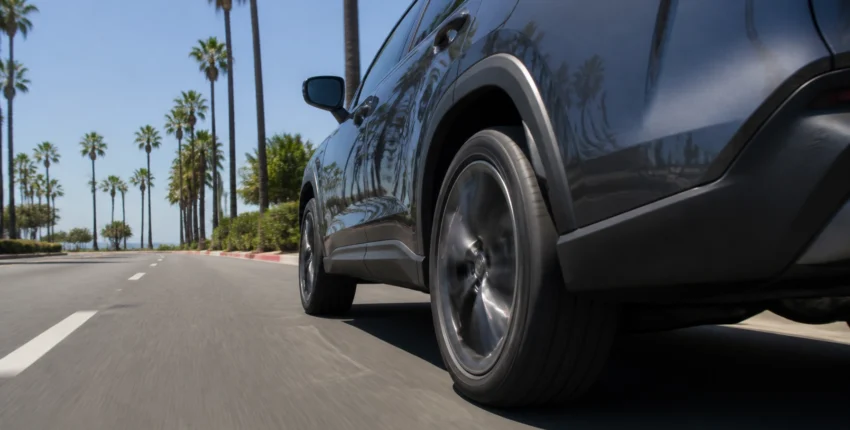
You’re driving down the 91 freeway, heading home to Riverside after a long day. The radio is off, the windows are up, and suddenly you notice it: a low, rhythmic thrum-thrum-thrum or perhaps a high-pitched whine that seems to get louder as you speed up. You check your mirrors, look at the cars around you, and realize the sound isn’t coming from the traffic. It’s coming from right underneath your seat.
Tire noise is one of those pesky automotive issues that usually starts as a “silent” problem: meaning it doesn’t cause a breakdown immediately: but it’s a problem you can definitely hear. For drivers in Riverside, where the heat is high and the commutes can be long, listening to what your tires are trying to tell you is a vital part of keeping your vehicle safe and your wallet happy.
Ignoring that weird hum isn’t just about tolerating a noisy cabin; it’s about catching a safety issue before it leaves you looking for tire repair near me on the side of a hot highway. In this guide, we’ll break down why your tires are making noise, how to diagnose the sounds, and when it’s time to stop by a trusted tire shop near me for a professional look.
Understanding the “Language” of Tire Noise
Not all tire noises are created equal. Depending on the pitch, rhythm, and when the sound occurs, your car could be telling you three different things. Usually, these sounds fall into a few specific categories that help us pinpoint the problem.
The Rhythmic Thumping or “Womp-Womp”
If you hear a repetitive thudding that speeds up as you accelerate, you might be dealing with “cupping” or “scalloping.” This technical jargon simply means your tire tread has developed high and low spots. It feels like a tiny rollercoaster for your tire. This is often caused by worn-out shocks or struts that allow the tire to bounce slightly as it rolls, literally “scooping” out bits of rubber over time.
The High-Pitched Whine or Drone
A steady, high-pitched hum often points toward your tread pattern. If you’ve recently switched between all season tires vs winter tires, you might notice a significant difference in volume. Winter tires have deeper, more aggressive grooves designed for snow and ice, which trap more air and create more noise on dry asphalt. However, if your regular all-season tires start whining out of nowhere, it could be a sign of “feathering”: where the edges of the tread blocks become rounded on one side and sharp on the other, like the teeth of a saw.
Squealing on Every Turn
If your tires sound like they’re screaming every time you take a corner in a parking lot or turn onto Magnolia Avenue, the most common culprit is incorrect tire pressure. Under-inflated tires have “soft” sidewalls that protest when they have to work through a turn. It could also be a sign of poor alignment, where the tires are literally being dragged sideways across the pavement instead of rolling straight.
Why Your Tires Are Getting Loud
So, why does a perfectly quiet set of tires suddenly start making a racket? For most drivers in Riverside, it comes down to three main factors: maintenance, alignment, and the environment.
1. The Importance of Regular Rotation
One of the most effective ways to keep your ride quiet is to stay on top of your maintenance schedule. One of the primary tire rotation benefits is the prevention of uneven wear patterns like the cupping and feathering we mentioned earlier. When tires stay in the same position for too long, they develop “memory” in how they wear down based on the weight of the engine or the angle of the suspension. Rotating them every 5,000 to 7,500 miles keeps the wear even and the noise levels low. You can learn more about why tire rotation is essential for your car’s longevity on our services page.
2. Alignment and Suspension Issues
Your tires are only as good as the parts holding them. If your vehicle is out of alignment, your tires aren’t pointing perfectly straight. Imagine trying to walk with one foot pointed slightly inward; eventually, your shoes would wear out in a weird way, and your legs would get tired. Your car feels the same. Poor alignment “scrubs” the tread, creating a noisy vibration. Similarly, if your suspension is worn, it can’t keep the tire firmly planted on the road, leading to that thumping cupped wear.
3. Riverside’s Heat and Road Surfaces
We all know how hot it gets in the Inland Empire. Extreme heat can actually make the rubber in your tires more pliable, which can accelerate wear if your alignment is even slightly off. Furthermore, the type of asphalt on our local roads plays a huge role. Rougher, older pavement will always produce more “road noise” than fresh blacktop. If the noise only happens on certain stretches of the road, it might just be the surface: but if it follows you everywhere, it’s definitely the car.

How to Check Your Tires at Home
Before you start worrying about how much do new tires cost, there are a few simple checks you can do right in your driveway to see if you can find the source of the noise.
The “Feel” Test
Carefully run your hand along the surface of the tire tread (make sure the tire is cool and the car is off!). If the tread feels smooth in one direction but “catchy” or rough when you slide your hand the other way, you have feathering. If you feel noticeable dips or “hills” in the rubber, you have cupping. Both of these are guaranteed noise-makers.
Learning How to Check Tire Tread
Knowing how to check tire tread is a skill every driver should have. You can use the “penny test”: insert a penny into the tread groove with Lincoln’s head upside down. If you can see all of Lincoln’s head, your tread is dangerously low (less than 2/32 of an inch). We have a great guide on checking your tread in under 3 minutes that goes into more detail.
Checking for Debris
Sometimes the “silent problem” is just a literal rock. Check your tread for small stones, nails, or screws. A trapped rock will cause a rhythmic clicking sound, while a nail might cause a slow hiss. If you find a nail, don’t pull it out yourself! That could turn a slow leak into a flat tire instantly. Instead, look for a professional tire repair near me to see if it can be patched.
When Should You Worry?
While some tire noise is just an annoyance, other sounds are a warning of an impending safety issue. You should head to a shop immediately if:
- The noise is accompanied by a vibration in the steering wheel or seat.
- The sound changes significantly when you turn or change lanes (this could be a failing wheel bearing, not just a tire).
- You see a visible bulge or “bubble” in the sidewall of the tire.
- The noise started suddenly after hitting a pothole or curb.
If you do need replacements, don’t stress about the price tag right away. Many people searching for cheap tires near me or best budget tires are surprised to find that high-quality, reliable rubber doesn’t have to break the bank. At Price Tires & Wheels, we specialize in finding that perfect balance between affordability and safety.
Finding the Right Solution in Riverside
If your car has lost its “silent” ride, it’s time to get an expert opinion. Whether you need a simple flat tire repair cost estimate or a full tire installation riverside ca, getting it handled early is always the cheaper and safer option.
Ignoring tire noise is like ignoring a flickering “check engine” light: the problem rarely fixes itself, and it usually gets louder (and more expensive) the longer you wait. A quick inspection can determine if you just need a simple rotation or if it’s time to invest in a new set of tires to protect your vehicle’s performance.
At Price Tires & Wheels, we’ve been helping Riverside drivers stay safe since 1987. We pride ourselves on honest assessments: if your tires just need a rotation to quiet them down, that’s exactly what we’ll tell you. We treat our customers like neighbors because, in this community, that’s exactly what you are.
Ready to get rid of that annoying hum? Stop by our shop on Vine St or give us a call. We’ll get you back to a smooth, quiet ride in no time.